
richard
lopez
Gonzales Food Market
311 Saint Lawrence St.
Gonzales, TX 78629
(830) 672-3156
gonzalesfoodmarket.com
“My granddaddy and grandmother were originally from
Mexico. They came over when they were young and newly married…1923,
I guess, something like that. But they became citizens…And Mexican
traditions — family, working together and, and eating together at
the end of the day and breakfast and you know—those are all part
of our heritage.” – Richard Lopez
Richard Lopez is the third-generation proprietor of the
Gonzales Food Market in Gonzales, Texas, a storefront barbecue restaurant
located on the town’s historic Texas Heroes Square. Richard grew
up in Gonzales, working in the market alongside numerous cousins and extended
family members. When his father decided to retire, Richard, who spent
twenty years working for the corporate grocery chain Albertson’s,
was eager to continue a family tradition. In spite of the long hours,
Richard wouldn’t have it any other way. Because of the family’s
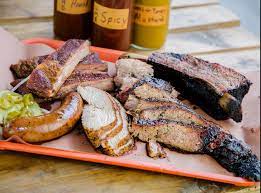
dedication to the business, Gonzales Food Market is famous for its sausage,
which is still made fresh, by hand, in the back of the shop. It’s
made following the fifty-year-old recipe that Richard’s grandfather
obtained from on old friend, Fermin Cantu, when he decided to open a barbecue
restaurant and grocery in 1958. Today, the market is operated by multiple
generations of the Lopez family. As Richard says, “Without these
people, the tradition and the success would never have happened.”
Listen
to this 2-minute audio clip
of Richard Lopez talking about what barbecue means to him. [Windows Media
Player required. Go here
to download the player for free.]
NOTE: What follows is a portion of the original interview
that has been edited for length. To download the entire transcript in
PDF form, please click here.
Subject: Richard Lopez - Gonzales Market –
Gonzales, TX
Date: March 6, 2007
Location: Gonzales Market – Gonzales, TX
Fieldwork Director: Dr.
Elizabeth Engelhardt
Fieldwork Team: David Croke and Brad Haugen – graduate students
at The University of Texas at Austin
Interviewers: David Croke and Brad Haugen
Photographer: David Croke
*Produced in association with the American
Studies Department at The University of Texas at Austin and the Central
Texas Barbecue Association.
---
Dave Croke: So, the present business was started by Feliciano
[Lopez], correct? And is he your grandfather?
Richard Lopez: In 1958 my grandfather, Feliciano, and my dad, Pablo, and
one of my aunts ventured into this business not knowing what they were
getting into. Because they used to have a business right behind us here
on the same block in back of us, and they used to run a beer, pool hall,
so they had no idea what to do when
they started barbecuing or running a grocery store. And it was just a
venture that was very successful. But, they didn’t own that, so
they took a chance in 1958 and it turned out pretty good.
So, who’d they go to learn how to build the pits and how to do
it?
Okay, the pits were preexisting, because, they came into this place—the
previous owner here before my grandparents and my dad came in here, his
name was Tony, and he bought a bigger place, more modern place, and he
left this one. So, this was vacated with a barbecue pit already in the
back. But, what they didn’t know was how to make sausage or barbecue.
Now, we give credit to an old man that was my grandfather’s friend
and his name was Fermin Cantú and he knew about making sausage
and barbecuing. Needless to say, he was about sixty eight years old, so
he helped my granddaddy and my daddy start this business up in 1958 and
my dad ran the grocery business and my granddaddy and the old man ran
the barbecue business, which wasn’t very much at that time; it was
just a neighborhood little grocery store with a barbecue pit to sell whatever
we couldn’t sell out of the meat market. You know, we used to have
steaks that you couldn’t sell, so we’d cook those, make sausage
or whatever you could. Very successful, they had a small business and
it was pretty good. So, during the years H-E-B came into town, and Super
S, and another chain, supermarkets, so we decided to close the grocery
business and just take over like a barbecue restaurant. So, even though
this—we call it a barbecue restaurant—it looks more like a
grocery store when you first walk in; you’ll see the grocery items,
bread shelves and sodas and beer on the racks, but it compliments our
barbecue because those are items that you need to take home with you when
you buy some barbecue. And the pits grew from one to three or four pits
in the back, and it’s been enormous business.
So, when you decided to make the transition, to do the barbecue and
eliminate the groceries, were there other barbecue places in town?
In 1960, or between ’60 and ’65, there was four more prominent
businesses barbecuing in Gonzales. We had Smith Meat Market, we had John
Davis Barbecue up on the hill by the armory up there, and then we had
Brichov. We had Tony’s, of course, which was a spin-off from this
business here; he ran down the street over here. And there was, I would
say, four more businesses in Gonzales. But, through the years they all
started closing one by one and we were probably the only ones left running
a business, a barbecue business.
---
So, how old are your sons now, and do you hope that they take it over?
Do you want them to put in that labor of love?
Well, I think every dad wants his son to be successful and have a good
career. Right now, both of them have pretty gainful careers. One’s
a banker, and the other one is working for the State of Texas in Austin,
and they have pretty successful careers after graduating from college.
So, I kind of, like, frown, saying, “you want to come down here
and run a barbecue business.” But, it belongs to the family. It’s
something to do with pride. We don’t work for anybody. It’s
a good profitable business, and you meet a lot of people, and you get
to love it. You get to love working in a place like this.
So, you mentioned you also had a successful career working for Albertson’s
grocery, a major corporation, and you came back when your dad needed someone.
Were you conflicted at all? Were you excited to come back and work for
yourself?
Yeah, coming back to Gonzales was something that I wanted to do; it was
in the back of my mind all those years that I was in San Antonio working
for Albertson’s. I always thought I could do better running a business
for ours, that belonged to us, instead of working for somebody else. And
at Albertson’s—all these huge corporations—you’re
just a number, you know, they can replace you in thirty-five seconds.
And there’s no pat on the back saying you’re doing a good
job. I mean, if you do your job, you’re okay, but if you don’t,
they’ll get rid of you—not saying that’s what we don’t
do here, but it’s just personal pride. Working for yourself. Having
your own business. Being successful. I don’t regret coming back.
I always wanted to, and I love it now. I don’t ever go to lunch,
because I don’t want to miss something that goes on here. My days
are morning until night and I don’t go golfing, I don’t go
fishing, but it’s something that I love to do, barbecuing.
---
You’re famous for your sausages, which were incredible, and you
mentioned that you have a little different mix to kind of distinguish
yourself from some of the Lockhart places. Do you feel like you’re
in competition with them, or like you’re all a community that attracts
barbecue
enthusiasts from around the state? What kind of relationship do you have
with all the other famous stops along this [U.S. Route] 183.
The sausage, if you go to Luling or Lockhart or Elgin [Texas], it’s
all different tasting sausage. You get different recipes and they were
brought in through the years, and they’re all successful because
they have their own original taste; they go back years and years, back
to the forties and fifties when we first started. Our sausage, the seasoning
that we brought together, the seasoning and the way we smoke them, the
way we cook them, is a blend that differs from any other because that’s
the way we try to keep it. Luling, I think, adds a little more pork and
they have a little different tasting sausage. New Braunfels adds maybe
more seasoning or something and they’re not as greasy. You know,
there’s always a difference in all the places that we go to. Our
sausage was started by this old gentleman that I was telling you about
that was partnered with my granddad, and this is his recipe and he passed
it on to my granddad. What we made in 1958, we’re making today.
We haven’t changed one item on those ingredients. I don’t
know, the success that we have on our sausage—people come from all
over the state of Texas to get this unique sausage—and it’s
been very successful; the recipe is with us to stay. We have added another
version to our sausage; it’s a pork and beef, spicy. And then we
have our original pork and beef sausage, little links of sausage—good
tasting sausage, we all love it.
We actually just met a customer who drove four and a half hours top
get some of your sausage: who do you see as your customers on a daily
basis? Are they more locals, or, you’ve gotten a lot of favorable
press coverage; do a lot of people come from far away?
Over the years, you notice that we do have a lot of local business, but
by far the business that we depend on for our big sales everyday in and
day out is from out of town. Either they’re going to have get togethers
or parties or weddings or just family get togethers in the backyard, they
come and get our sausage. I took a survey, like I was telling you, about
where people come from, and on a Saturday, out of twenty people, eighteen
of those were from out of town. They’ll come and get a load of sausage
to take back to wherever they’re going. Sometimes, I feel like I
don’t see how we can keep up with the demand, because during a normal
weekday we’ll probably sell about three- to four-hundred pounds
of sausage, maybe even five hundred, but on a Friday you double that,
maybe you sell eight hundred pounds of sausage. On a Saturday, you maybe
quadruple that; we’ll sell fifteen hundred pounds of sausage, easy,
on a Saturday.
---
Do you think demand for that type of product has gone up recently?
Have you noticed any changes in your customers, or who do you think is
interested in that kind of product?
You always have the thought that maybe we should commercialize and make
that product available, maybe to a person in Houston, Texas, shopping
at a local grocery store, but I think that if we went into that kind of
business we would lose the quality that we have: the small batch, the
hometown operation, the freshness that
we have. Because, when you start thinking like that, you’ve got
to commercialize instead of using small batches, you’re making giant
batches with mechanical ingredients and all this kind of stuff, and you’re
not smoking it the way you’re supposed to, the way we do. And I
think we would lose that. We meet the demand that comes to this place.
If we were to venture out and market this somewhere else, I don’t
think we could meet that demand, even though it is a good financial compromise
to think like that, venturing into a commercial.
Do you ever worry about health concerns, or that you might lose customers
because of increasing awareness of health issues? How much sausage do
you eat?
I try it every day. Every morning I cut a sausage and I taste it and it
makes me feel good that, if I like it, the business is okay for the day.
It’s like a quality control test. I’ll eat one in the morning
and I’ll say, this is okay. That makes me happy and we continue
with that. It’s never going to change. It’s just something
that I have to do to guarantee my quality control. And, when I first started,
I weighed about 200 pounds and now I weigh 275. So, you know, I’m
eating a lot of sausage, right?
---
And where do you get your chicken, your beef? Is it all from the same
place?
Uh, no. Everything is different companies. We, we deal with about, maybe,
up to about seven or eight different, uh, suppliers. Excel in San Antonio.
We have three or four meat companies that deliver to us on different parts
of the week. We have a chicken poultry plant that delivers our poultry
from Moulton, Texas. All our supplies come out of San Antonio. Sysco,
Ben E. Keith, uh, we have suppliers that come in.
And are these pretty consistent relationships for a long time or are
you always looking for someone new or something better?
Oh our suppliers have been the same forever. We don’t try to change
them because they, we, through the years, they are consistent with their
supplies and they’re fresh and we have, you’ll run into occasional
problems but nothing to worry about. We, we have pretty good relationships
with all our suppliers. They come in quite frequent: Monday mornings,
Wednesday mornings, Friday mornings. Everything’s fresh.
---
Yeah, you mentioned trying the pulled pork on a fajita and on the kind
of exchange with Mexican barbecue traditions. Is your family originally
from Mexico, or—
My granddaddy and grandmother, uh, were originally from Mexico. They came
over when they were young, and, and newly married. Twenties I guess. Twenty—1923,
I guess, something like that. But they became, citizens, and, they are,
are from Mexico. Matter of fact, my grandmother didn’t know a word
of English; up until she died she couldn’t talk English. And, Mexican
traditions — family, working together and, and eating together at
the end of the day and breakfast and you know—those are all part
of our heritage.
So in, in this area do you have a lot of Tejano customers and do they
like any different kind of barbecue, or—
If you’re familiar with barbacoa, you get the—that’s
a beef head at tacos that you probably get those in any Mexican restaurant
you go to and those are pretty popular. Now that’s, that’s
kind of like—barbacoa and barbecue almost sound like the same thing
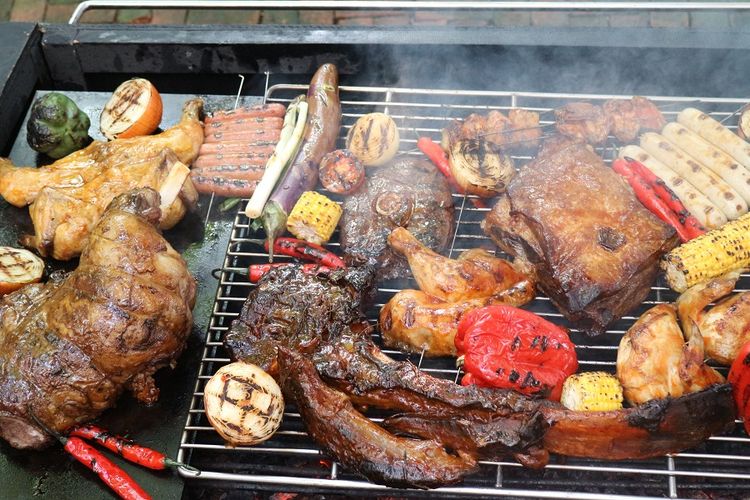
but they’re really different. Uh, barbecuing, uh, it’s kind
of like cooking briskets, uh, and chickens and ribs over a wood fire for
a long period of time until they get smoked flavor and tender and, and
then you have grilling, which is directly over the charcoal and we have
two or three different ways that we cook back there. We have a beef rib
that we put on pans and we keep away from the fire and it’s kind
of like a baking process. Beef ribs, you put about fifteen or twenty pounds
of beef ribs in a pan and put it away from the fire and you have a baking
process. Our steaks and our chops and our chicken and our pork ribs we
put directly over the charcoal, over the wood coals and it’s kind
of like a direct cooking. Now our briskets and our sausage, we cook indirect,
where the fire’s way off on one side of the pit and the brisket
and the sausage is on the other side, slow cooked. So, we threw all of
these, uh, cooking systems and we call it barbecue. It’s all barbecue.
One way or another, you’re still cooking with wood and there’s
no gas, there’s no electricity back there, it’s just wood.
It’s all wood smoked.
So for you the essence of barbecue, what makes it barbecue is that
it’s being smoked by wood.
I’ve been to barbecue places where they have a rotisserie with a
gas-fired oven, and they use one log throughout the whole day and call
it barbecue. Uh, that to me is kind of like, uh, mis-advertising or, and
that’s not barbecue. Barbecue, if you don’t have no smoke,
you ain’t got no barbecue.
---
And I noticed you also have a mail-order business. When did you start
that?
I
don’t know if too many people are aware of this but the health department
came down on their last visit and kind of like instructed us that we could
no longer have a mail out program because we have the wrong type of license.
We have a retail, on-the-premises only type of license. And to get into
the mail order, we would have to have a manufacturers shipping license,
which is totally different. And there’s nothing wrong with that
and we, we, we accepted that because now we have to take another step
and get a bigger license, where you have a USDA inspector in the back
and make sure all your temperatures in the water are correct when you
wash dishes, when you, when you do your floors, your ceilings, your, your
temperatures on your cooking, how you cook, when you take it out, how
you cool it down. Your cooler sanitation process, that’s all involved
in the wholesale license and we’re willing to do that. Only thing,
it’s going to cost us some money to renovate and we’re kind
of like, put it one hold for a while. But yeah, we did a lot of that shipping
before we got our hand spanked and we been shipping sausage, maybe since
Jesus Christ was the little boy, back in the fifties and they never said
anything. But then all of a sudden, here they come and said, “You
can’t do that no more.” So, we accept it.
But you are ultimately going to try and get the new license, and, who
do you tend to ship to? Customers like the guy we met who drove four and
a half hours, or do you want to try and get into new markets where people
have never come to the actual restaurant?
You know the, the license, when you get a wholesale license, you’re
qualified to advertise on the Internet, which is a future for all of us.
If you can Internet on the—if you can advertise on the Internet,
you might have some people try our sausage and we can ship it directly
and do the whole thing over the—over the network. People that have
lived in this area and move out—we had California, we has a Washington,
we had Colorado, we had New Mexico, we had Las Vegas. People just move
out and they want that old Texas sausage that they’re used to and
they call us. “Can you ship me some sausage?” Well, we tried
to do whatever we could to get those orders shipped out and it was a pretty
good little business while it lasted and—service guys. When you
go overseas or something they call mom and dad and tell, “Can you
send me some sausage, please?” One guy wanted some in Iraq, and
obviously you can’t, it takes too long to get there, they’ll
spoil. But the thought of it, and him asking was nice. That was nice.
---
And do you have an, a favorite barbecue restaurant? Do you ever eat
barbecue outside of here?
When me and my wife go on trips like Houston or—or we go up north
and visit parks or whatever, when we have a little time off, I’ll
stop at every barbecue place I see. And she hates me for that, she hates
me because I’m always trying something different to see if I can
better my restaurant. And, it’s like a—it’s like a—spying
you know? It’s just like you’re going behind closed doors,
you know? You know, I mean and—but it gives me ideas and that improves
my business. And, I’m not going to do theirs—they just gave
me an idea, which they’re welcome to come down here and look at
my place and I’m sure they do. You know, all, all barbecuers all
over Texas. Always getting – trying to get new ideas. One time I
went to Seguin and it was called Smoking Charlie’s, and I changed
my hat. I put on a regular Astros or a Cowboys hat, sunglasses and I went
in there incognito, right? And I was just looking at the place cause it
was brand new and one of the guys in the back says, [yells] “Richard.
How you doing?” And I said whoa, there goes my cover. I been discovered,
right? Needless to say I was embarrassed because he knew I was in there
looking around, but I’ll always try to get ideas. Even prices you
know, you have to be competitive. You – plates. You know? You always
try to see what they got. I don’t ever call them, I go look at it.
---
And did you have your sons working here before they went off to college?
Well, see, the twenty-five years I was in San Antonio, they grew up in
San Antonio and, and from there they went off to college. But both of
them have been here working during the summer to make—for gas money
and to get a little bit of spending money and you have to work just like
everybody else so I can pay you. So, yeah, they have been. As a matter
of fact, I’ve, I’ve had some thoughts about opening a second
business in Seguin or San Antonio and they told me that if it looks pretty
good, if the restaurant looks pretty enterprising, they’ll probably
jump on board. I don’t know. That’s just something in the
future.
But you’re excited about that prospect?
You know anytime you can better your, your life and, and buying another
business or getting into another business and it’s all family operated
and your sons are—it’s something that you’re working
on. And it, it’s a, a payoff in life. I don’t know. Maybe
it’s more headaches and more hours, you know, everybody’s
working harder. I don’t know whether I’m doing good or bad.
But I see it as a good thing, you know? To better yourself.
Yeah, what does barbecue mean to you?
Well you know, you can go to the back yard and put on a barbecue pit and
either put some charcoal in there or, or—but it’s, it’s
a way of cooking that goes back to the cave people, I guess. You know
when you cook over a fire, it’s just something beautiful about that.
You—you smell the smoke, you know, and it smells good. You’re
cooking and you’re doing it outside the house. You’re not
depending on the old—on the wife, the old lady to cook it for you.
You’re cooking it yourself and you get pleasure out of that. And
barbecue, smoking over a fire—the smoke flavor and
the, the outcome is the—it’s something that everybody just
can’t, they can’t do it. I mean one guy told me, “I
tried to cook a chicken and every time it’s either raw on the inside
or overcooked on the outside or what have you,” and I says “Well,
it takes—it takes a little practice and, and you’ll eventually
get it if you’re in there long enough and, and—” We
been here 48 years so all of those things come easy to us. And, and it
tastes good and people love barbecue. I don’t know how to explain
barbecue. It’s just different way of cooking that people love. And
we love to make it, and we love to have the people come in and try it
and come back over and over and over, like that gentleman that you saw
coming from Edinburg. He said he was here, what? The last time he was
in, pretty close to Gonzales, he came and got a load of sausage and now
he’s coming back—another opportunity to get some sausage.
And that, to me, is satisfaction. It’s barbecuing because people
love it.
That’s great. Anything else special about this business we need
to know?
You know this, it’s run by a lot of people. And the success that
we have is all these people uniting and working together day in and day
out, sacrificing over the years. And we don’t have hours like other
normal people, eight to five. Our hours are whenever we’re needed,
we’re here. And however long it takes, we’re here. And all
I want to do is just pay tribute to those people that were here for years
and years, and they’re gone now. They’re—they’re—they’ve
lived their—they made their forty—twenty or thirty or forty
years and some of them have left this life, but those are the people that
really contribute this business. And—long hours. A lot of sacrifices.
And to us, we have everything because of those people.
So we carry on a tradition that’s, that’s been here for a
while—for long times. It’s unique, it’s different, and
we love it.
---
To download the entire transcript in PDF form, please click
here.
bottom MENU
Introduction
| Interactive Map | Oral
Histories | About & Contact | More
Trails...
|
 |