
vencil
mares
Taylor Café
101 N Main St
Taylor, TX 76574
(512) 352-8475
“I just have a little different seasoning, but that’s
how I got started and then people just wanted my sausage, the way I make
mine. I put a little more seasoning in than they did, you know. And put
a little more meat in, too.”
– Vencil Mares
Vencil Mares was born on November 10, 1923. A native Texan,
Mr. Mares returned home from WWII and went right into the barbecue business.
He began in Elgin, Texas, at the Southside Market in 1948. It was there,
working in the smoke pit, that Mares learned the secrets of the barbecue
trade, including how to make his much acclaimed sausage. A year later,
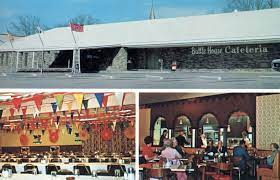
he purchased what is now Taylor Café in nearby Taylor, Texas, and
has been the owner and operator of the establishment ever since. Taylor
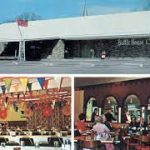
Café's hundred-year-old building is as distinctive as Vencil's
ketchup-based barbecue sauce, complete with jukebox, mismatched bar stools,
and an antique cash register. Though the Taylor Café has been housed
in the same building since it opened, there have been a few changes. Some
years ago, for example, Mr. Mares added turkey sausage to his menu. But
Taylor Café is still, at its heart, the same barbecue joint that
it was in 1948.
Listen
to this this 2-minute audio clip
of Vencil Mares talking about Elgin hot guts, his sausages, and the cuts
of meat he uses. [Windows Media Player required. Go here
to download the player for free.]
NOTE:
What follows is a portion of the original interview
that has been edited for length. To download the entire transcript in
PDF form, please click here.
Subject: Vencil Mares, Taylor Café –
Taylor, TX
Date: February 28, 2007
Location: Taylor Café – Taylor, TX
Fieldwork Director: Dr.
Elizabeth Engelhardt
Fieldwork Team: Marsha Abrahams, Gavin Benke, and Remy Ramirez
– graduate students at The University of Texas at Austin
Interviewers: Gavin Benke, Remy Ramirez, and Marsha Abrahams
Photographer: Marsha Abrahams
*Produced in association with the American
Studies Department at The University of Texas at Austin and the Central
Texas Barbecue Association.
---
Gavin Benke: The first question we have about your barbecue
is where you learned to barbecue.
Vencil Mares: I learned how to barbecue in Southside Market, and I stayed—at
there in ’48 and I come back and bought this here and I run this
thing ever since…I learned how to barbecue in Elgin, Texas—Southside
Market.
And who taught you there to barbecue?
Well, it was Van Zimmerhanzel and the Stachs; two brothers in there and
I went to work for them. That’s how
I learned how to barbecue and make sausage or whatever over there.
Is that where you learned to make the Elgin hot guts?
Yes, uh-huh. I learned how to make an Elgin hot gut. I just have a little
different seasoning, but that’s how I got started and then, uh,
people just wanted my sausage, the way I make mine. I put a little more
seasoning in than they did, you know. And put a little more meat in, too.
[Laughs] Of course, at that time, they just making hot guts. Right
now, I’m making turkey sausage and beef sausage and started making
pork sausage, too. But that’s my own recipe, there. So, uh, I serve
quite a few turkey sausage, because it’s not fattening is you’ve
got twenty percent pork and eighty percent turkey. So, it shouldn’t
not be that fattening. And we just go and just smoke them up and if they
want them get hot how you can eat it that way or you can finish cooking
it yeah. And we learned how to cook briskets too. So them briskets—our
briskets [indiscernible] meat and some of them Sysco and we trim them
up first before we put any seasoning on it. We trim them and take the
trimmings off and add some lean meat to it and make sausage with that
so we don’t have no waste, but the reason you trim them so you don’t
have too much fat, but if you leave too much fat on there and you cook
them that way—you put seasoning—so that when you bring it
up they’ll say “Well, I don’t want that much fat,”
so what happens there, you go ahead and you cut that fat off, so you’re
cutting all the seasoning off. You don’t have—Your brisket
have no seasoning. See? That’s the reason you need to cut that fat
off first, and then season it and cook and you 1 don’t have to cook
it anymore. See? And that keeps your seasoning in. And also when you put
them on the pit, you know, you got a heavy end and a small end. So this
is the heavy, I’ll say this is the heavy end and this—back
end. So you put them on the heavy part forward [indiscernible] and put
them with fat side up, not the bottom like that, fat side up; but your
reason for that is to, fat side up, is when that meat starts cooking,
then that juice and the seasoning start penetrating through your meat.
But if you turned it over, all your juice go down the drain. See? So,
you’re right back where you started.
Remy Ramirez: So you learned a lot from them.
Oh, yeah. Of course, they didn’t do it. This is my own doing. They
just—they cook a lot, like a, of chuck and different kinds of meat,
you know. So, that’s what I learned over there. And then, after
we get it done just about you stick your fork in and just like if it grabs
a little bit and kind of holds, it’s not done. When you put that
fork in, it slides out real easy, then the thing is done. So now what
we do is take it up and wrap it up in a, wrap it on a butcher paper, wrap
it up good, while it’s good and hot. And the reason for that is,
because when you put it in a, then we put it in a ice chest, a regular
ice chest. Wrapped it up good and then we shut the ice chest down and
see that’s real hot and it stay hot eight, ten hours in there. And
what happens there, it tenderize the meat and you keep in all the juice,
see, and it won’t dry out and it’ll still be hot, ten hours
it will still be good and hot, see. And it turns it real tender, see.
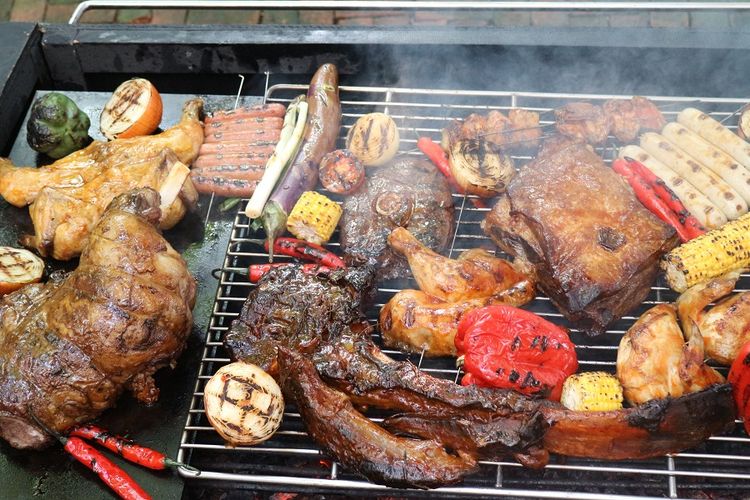
And chicken’s the same way, you put them, lay them down like that;
you don’t turn them over, lay them down at the beginning. Some of
them you test them by the wing and some of them tell by the hind legs
that twists, that twist it, that twists it’s pretty well done, but
if it doesn’t twist you better let that chicken on because ain’t
nobody want no raw chicken…raw chicken a fast eater – wouldn’t
get in an argument say “that’s my fault” and take the
bait. So, same thing with the pork ribs. We got them. We just put them
up; we don’t ever turn them over. Get them done.
GB: Mr. Mares, about what time during the day do you start cooking
your meats?
Well, I’ve got a man come up here about four o’clock in the
morning. And we got all that season—then you season your meat, you
season it two days ahead of time, cause that’s the way you give
a chance—your seasoning a chance, your seasoning, to penetrate in
that brisket, the meat, you see. So he starts, gets here about four, put
that meat on at five o’clock. It’s done about eleven o’clock.
It all depends on how big—some of them are going to get done a little
early cause you got smaller rib brisket, you know and if they’re
bigger well you just leave them alone. Don’t put them on [indiscernible]
because you say “no, no,” it ain’t going to work [laughs].
And once the meat starts cooling off, it starts kind of shrinking, getting
tough. You need to finish it out and then wrap it. If you don’t
do that, you’re in trouble. You’re going to be like rubber.
And then, I don’t know, what else? We link our sausage sometimes
and—’cause the reason you link them, you make more profit,
you don’t have to—you don’t lose no wasting. So you
got to figure out how much links cost you. So that way you just to figure
out how much you need to get for it so you don’t have to throw it
on scales, you just got to weigh it out in fours, you know. You got to
pound, that might be four links to a pound. So you figure out how much
you need you get a pair of link and you don’t even have to weigh
them. And it’s a lot easier to keep the juice in it, too, see?
GB: You mentioned that you use a pit, have you always used a pit?
The pit? Oh, yeah, yeah. We got regular wood; post oak wood. So we just—post
oak wood getting high, you can’t hardly find, $140 a cord. So, no
mesquite wood, nothing like that, it’s just pure, post oak wood.
In fact, I got a load in yesterday. I just
got about ten cords now, I need to get about ten more [indiscernible]
if I’m going to stay here [laughs]. I guess I will. I don’t
have anything else to do anymore. I’m too old to do anything else—too
old. No, I ain’t got too old for deer hunting. It stinks—I
can’t climb trees like I used to. [Laughs]
GB: Have you always cooked your barbecue that way?
Oh, yeah, yeah…That’s the only way to cook it. Of course,
you have to learn first what you had to do but once you learn and whatever
you took to do it and that’s what we’re doing and that’s
still doing it.
GB: And with the turkey sausage, when did you start making
the turkey sausage?
Oh, about ten years ago. Just my own recipe. Making—put your own
seasoning in there. Of course [indiscernible] says “How you make
this thing?” I says, that’s why, I never tell them the truth,
you know, [indiscernible] and then try to take my business away. It ain’t
nothing to it, just—but if you miss just one item it won’t
work out. It won’t be the same. You know, “I did what you
told me, it didn’t come out like yours.” [Laughs] That’s
part of my living, you see. So I pray to get down there in the morning
[indiscernible], people always come in and drink coffee, they ain’t
got nothing else, they’re older people, they ain’t got nothing
else to do but arguing; they get into arguments. Once somebody gets the
best of them, most of the time, they get up and leave. [Laughs]
That’s the highlight, every morning. You can’t even find a
park—car place. I just make a pot of coffee, I just let them drink,
let them have at it. Some of them gets pretty tight. Instead of paying
at least fifty cents for the coffee and slip a quarter in there it’s
a quarter and a nickel. [Laughs] I don’t know, people just
that way; you find people like that. If that fifty cents too much I just
give a quarter and a nickel, nobody going to see that—a quarter
and a nickel both look alike. I don’t say nothing. I say, “Let
them have it. It ain’t but colored water anyway.” [Laughs]
So when it runs out I say, “That’s it.” I don’t
make no more. What else?
GB: You mentioned that you started in ’48 in Elgin, at the Southside
Market.
Yes. That’s where—I started working in a meat market over
there, and then, they had a barbecue pit back there, so—So they
put me in the hot spot. [Laughs] So I worked back in the pit selling
sausage and cooking them, you know. They’d like have Chuck seven
or any kind of pieces of meat, you know; your rib, beef ribs, and chicken
and stuff like that. Them days, they didn’t hardly ever cook any
briskets them days. They didn’t know what to do with them. But eventually,
people start cooking them, and they couldn’t hardly get enough—I
remember when they was thirty-nine cents and people didn’t even
want them, the people that had them. But somehow or another they got started
on brisket and now can’t even get enough briskets. It’s a
boneless piece of meat, you know, and you don’t have no waste…But
if it’s too much fat, you can save that fat and just go ahead and
get you some lean meat and make your sausage with it, you see. These days
you can’t throw nothing away. It’s a hard game. I don’t
know, anything else?
GB: What made you decide to open the Taylor Café?
Well, I figured that if I could make some money for some other person
up there and paying me, I figured that I go into my business, I know what
to do now and I can do in my business, why shouldn't I make the money
for myself? So I did. But it's a hard game. So that's the way it went.
Sometimes I stayed at the stuffer up there—the two hundred pound
stuffer and stay there until all evening making about two thousand pounds
of sausage. So that's the way it went, you know.
GB: When did you open the Taylor Café?
1948. In 1948 we opened up. We just started. We used to cook chili and
stew and stuff like this.
---
GB: Mr. Mares, could we talk about your sides, your side dishes. Um,
have they always been the ones that you serve now?
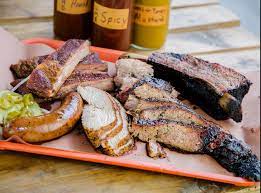
What I serve, you know right now? Well, I serve regular barbecue plates,
with beans and potato salad, onions and pickles, but you can get jalapeño
peppers if you want to. And then you also have the same plate, you can
get the sausage with it, it would be a mixed plate. Or you either have
a rib to go with it or either or a rib plate, or also all your regular
sausage plate with the same trimmings, you know.
RR: Has it always been that way, or did you change it?
Well, they used to serve sausage out and they used to didn't have no plates
you
know until I came and changed all that up to having plates. They used
to just get
a piece of paper and serve the sausage on a piece of paper, you know.
I guess
Louis Mueller still does. [Laughs]
RR: Over there? [Pointing towards the street where Mueller's restaurant
is located]
Yeah, but hell…I don't see where he gains anything by that. They
put it in a piece of paper you got to get another cup or something to
have your onions, but not your onions, but sauce. And the paper is going
to go through. And you still have a greasy table, so you still got to
go. So the plates won't cost you any more than that piece of paper, see.
And then if you want to put sauce on it, well you got a plate where you
can put your sauce on it. But everybody got his ways, you know.
RR: Was this building already here when you opened your business?
Oh yeah. This building's been here. It's over a hundred years old. I got
a picture of it in 1892. Used to be a two story and the top burned down.
So they just cut the top off and made it a flat building, like it is here.
There used to be, I think it was a saloon downstairs and a rooming house
on top. They called it K-A-M-P, Kamps. Kamps, uh, hotel, or something,
I think. Kamp's Hotel. K-A-M-P, Kamp's Hotel, is the name of it.
RR: After it burned down, is that why it was vacant? And that's why
you could open up?
They never did stop though. They stayed open the whole time.
RR: And you just bought it from them?
Well I just bought it from my cousin. He bought it and in turn, I bought
it from him. If I can pay rent I can afford to pay down on it. See, once
that rent is paid it's gone. If I can't pay for it, here it is. It's a
disaster. What, see what you’re doing. It didn't take me long to
pay it out. The way I paid this thing out is with them jukeboxes and a
pool table there. Also, I borrowed the money, I think. It took me three
years to pay it up…with all the payments I could put. They'll tell
you what you'd get every week you have these jukeboxes and pool table
and whatever my part takes in, you go ahead and take it down for payment.
Three years time I had it paid for. Don't have to worry about no payments
or whatever I let him keep up with it. So that's how it got paid out.
Then I bought that other building too, later on.
GB: Mr. Mares, when we came in I noticed a couple plaques and ribbons
on the wall from winning competitions.
Yeah, that was, we won the first place in Elgin, Texas in the cook off.
In Elgin. That was last year. April, April. We won the first place in,
in3⁄4 I guess it’s briskets. Won first place, then we won
second place somewheres. I believe, it has to be just, you know I mean
ah 3⁄4 so ah, well I think we got $300 there, and a four-horse trailer,
and something else to go with it. That was first place in Elgin. That
was last year.
---
GB: Do you, have you always done the barbecue cook offs when they hold
them?
We just kind of started about eight years ago, something like that. I
let them go at it, I go a couple times with them. Kind of show around
a little bit, you know. Act a big dog, act a fool. So, it’s kind
of new to me, you know, it’s hard to work up, work, work at, there’s
a big, big pit, and a tent, well you had, if you want to eat something,
well you have to have a little deal to cook. Stay overnight, start cooking
about two o clock in the morning. Have the thing ready by ten o clock,
or the times when it’s judged, but. Set up all them tents and find,
and pay so much to get in, you know. So, if you win you win, if you didn’t,
you didn’t. Anything else with me?
GB: Could you tell us a little bit about your, your barbecue sauce,
is that your own recipe?
Yeah, that’s my recipe. You get you some ketchup started, and I
mix it with a can of, some ketchup, and then I’ll, you can add on
tomato sauce to it, you can take a little bit and put you some lemon,
lemon, slice up some onions, and celery, slice it up, put a little sugar
in it, and Winchester sauce and a little Louisiana hot sauce and add a
little butter, butter, then just cook it. You get your other ingredients
cooked
first and then put your ketchup stuff like that in there. But you, a little
sugar in there, Louisiana hot sauce, hot sauce. That’s about it,
you just have to keep, you don’t want to get too much water in there
because if you get it too thin you ain’t going to have nothing,
then have to add a little sugar, brown sugar what you’re supposed
to use instead of regular sugar.
RR: Well, you’ve already told us that you make your own sausage
here, right?
Yes ma’am.
RR: And you make beef and turkey, that’s right?
Yes and pork sausage, too. I just started. I just hadn’t had time
to fool with it. But I, last two weeks I did, I made some yesterday.
---
RR: Is there anything that you wanted to tell us about that we haven’t
asked you about?
I don’t think we missed anything that I know of.
---
To download the entire transcript in
PDF form, please click here.
bottom MENU
Introduction
| Map Overview | Oral
Histories | About & Contact | More
Trails...
|
 |