
jim
mcmurtry
Smokey
Denmark Sausage Co.
3505 E. 5th Street
Austin, Texas 78702
(800) 705-1380
smokeydenmark.com
“We make quality products. We’re not the only
manufacturer who makes quality products, you know, a quality sausage.
But then everybody knows that there’s sausage and then there’s
sausage.”
– Jim McMurtry
Jim McMurtry and his family have owned Smokey Denmark Sausages
since 1972. In that time, Mr. McMurtry has expanded his factory, updated
production methods, and brought his daughter and son-in-law into the business.
Though a lot has changed at Smokey Denmark in the last thirty-five years,
Mr. McMurtry, a genial, proud, and funny Texan who manages to juggle a
second job as a lawyer along with his Smokey Denmark duties, has remained
a constant presence in the factory in East Austin. Here, workers, many
of whom are long-time employees, create sixteen different kinds of sausage,
as well as brisket, chopped barbecue, and spare ribs. Smokey Denmark supplies
many barbecue restaurants with sausage, and Mr. McMurtry says that his
relationships with these restaurant customers have become treasured family
connections.
Listen
to this this 2-minute audio clip
of Jim McMurtry talking about how the Smokey Denmark product line has
developed over the years. [Windows Media Player required. Go here
to download the player for free.]
NOTE:
What follows is a portion of the original interview
that has been edited for length. To download the entire transcript in
PDF form, please click here.
Subject: Jim McMurtry – Smokey Denmark Sausage
– Austin, TX
Date: March 26, 2007
Location: Burdine Hall, The University of Texas at Austin - Austin,
TX
Fieldwork Director: Dr.
Elizabeth Engelhardt
Fieldwork Team: Rebecca Onion and Lisa Powell – graduate
students at The University of Texas at Austin
Interviewers: Interviewed by Rebecca Onion and Lisa Powell
Photographer: Lisa Powell
*Produced in association with the American
Studies Department at The University of Texas at Austin and the Central
Texas Barbecue Association.
---
Rebecca Onion: [S]o I wanted to try to start with a little
bit of the history of your ownership of the business, so if you could
talk a bit about how you came across the opportunity to buy it, how you
made the decision
to do so, what state it was in at that point, things of that nature?
Jim McMurtry: Well, back in 1972, I got a call from my brother in law.
And he said, “Jim, there’s a sausage business for sale over
there in Austin.” And he was calling me from the Bryan, College
Station area, so he said, “There’s a sausage business for
sale over there, and why don’t you go over and nose around and see
if that’s something that we ought to do, we ought to buy?”
He said, “It’s Smokey Denmark, and Mr. Denmark has had a heart
attack, and his doctors have told him that if he intends to live very
much longer, he has to stop working so hard.” And so I said, “Well,
Cliff,” my brother-in-law, I said, “Cliff, we don’t
know anything about making sausage.” And he said, “Well that’s
all right, we have enough expertise available to us through Texas A&M
to be able to learn the business, and we’ll have a manager to manage
it for us.” So I went out to the sausage plant and I met with Mr.
and Mrs. Denmark, and they provided us, provided me with information,
answered every question I had, let me observe the practices and procedures,
and I talked to their banker, and that sort of thing. And I am very conservative,
especially when it comes to finances, and it looked like to me like it
would at least pay for itself. So Cliff and I decided that we would buy
Smokey Denmark from the Denmark family, none of their family members were
interested in taking over the business. So we bought it, November 25,
1972….
Smokey and Eloise moved here and opened this business in
1964. They had lived in the Lockhart area. A few years ago, I looked back
in the old archives of the Austin Public Library, and they had old telephone
books there. And I noticed that the telephone number that we have today
is the same as they had in 1964.
Wow. But a lot of other things have changed, as we will discuss! So
when you bought it, what kind of—did you have plans right away to
change things or to expand, or did that idea come later?
Actually, we, if you’re in business making a product, I guess you
always have the desire to make more and sell more product, but I remember
a statement that my brother in law made, he said, “Here we are making
three thousand pounds of sausage a week,” and he said, “if
we can just ever get it up to five thousand pounds, that’s all we
need.” Well, today we make between thirty and forty thousand pounds.
And if I think—the wisdom that—not the wisdom, but the hindsight
of that is—if we were at five thousand pounds today, we wouldn’t
be in business. I mean, you have to get bigger, or you have to get out.
Are there any, I guess, examples of smaller companies—you don’t
have to name names, but was there any negative example you learned from
watching?
In what sense?
Over the years—you were saying that if you stayed smaller, you’d
have a harder time claiming a share—
Yes, well, I think that actually Smokey Denmark in the days around 1970
probably would have been a good example in itself. Because that’s
when meat inspection came in, and if you were, the smaller you were, the
more difficult it would consequently be to be able to conform your practices
in your plant, to abide by the government regulations. And that’s
what Smokey was actually facing. He had a business that was going, but
in the facility where he was, which isn’t all that far from where
our plant is today, but that facility would not pass government inspection.
So they gave him a little time to build a new plant, which he did, and
that’s about when he had the heart attack.
And what particular kinds of physical aspects of the plant were not going
to come up to code, that he would have to change, or that you changed?
Well, not having seen—because by the time we bought the business,
the new, that we called the new plant was constructed and he was operating
it, and the facility he had had before was a barbecue restaurant or something
like that, but I think most
of it probably had to do with sanitation and the ability to wash down
areas. I know that the building where he came from does not have floor
drains or sloping floors, I’m not sure what they had on the walls,
but we can wash every wall in the production related areas of the plant,
have it all drain down the drain, and I know they couldn’t do that
where he was.
---
Lisa Powell: I just have a couple more questions for you. In part to
go back to the idea of the history of the business a little bit. Did Smokey
Denmark give you any advice when you took over the business? Are there
any sort of words of wisdom that he passed on to you?
Well, yes. And I think that Mr. Denmark—Smokey as we call him—he
gave us advice that is, I would say, the cornerstone of our operation
and our planning and everything—our standards and everything even
today and it will be, I think, forever. I remember him saying—when
we bought the business—he said that “you’ll probably
never be an Oscar Meyer.” And he named off some others. He said,
“They are bigger than you are, they have larger production facilities,
they buy in larger quantities, they have advertising budgets.” “But,”
he said, “you can do those things that they can’t do or they
won’t do.” Well, I’m convinced they can do just about
anything that they would want to do, but they don’t want to do the
things that Smokey Denmark does. And so that has been our niche over the
years. We don’t feel like we compete with the big guys. We don’t
feel like we compete with those who make products that are inferior to
us. You know quality has very few competitors. And so, that’s been
kind of a guiding principle for us. We do those things that—we make
quality products. We’re not the only manufacturer which makes quality
products, you know, a quality sausage. But then everybody knows that there’s
sausage and then there’s sausage. But everything we make is a premium
quality. So I think those are words of wisdom that, well, that’s
been our niche and you can trace that all the way back, not just to what
Smokey said, but the way that Smokey ran his business, too. He only had
two products, but they fit even today in that same definition.
---
RO: So how does that happen, how do you develop recipes? Without getting
too specific into trade secrets?
When you visited the plant, I may have made the statement that there are
no secrets in the sausage business. And most people, they might say, you’re
crazy. But given enough time, enough trial and error, enough patience
on the part of the customer, you can usually pretty well match what someone
else has done. Or you can tweak the flavor profile, or the texture profile,
you can tweak it by again, by trial and error. By taste and by looking
at it. So that you can make just about what anybody thinks they want.
And that’s the way I would say that most of the recipes have been
developed. Somebody had a particular need or a particular product they
desired for us to try to do, and given enough time, we have been able
to satisfy those kinds of requests.
RO: So who ends up taste-testing it on your end? Do you do it?
Well, it’s kind of a group effort. Usually, someone is working,
either Jonathan—my son-in-law, my partner—or myself, is working
with the customer, the relationship develops, sometimes it’s both
of us and the customer, but because we have an interest, we are very much
involved in the taste testing and the analysis—taking a knife, cutting
it open, seeing if it’s binding, the meat’s binding together,
tightly or loosely, or whatever the objective is, and then working with
the customer too, to say “How is this?” and they might say,
“We’d like a little more black pepper,” or whatever
it might be. It’s fun, though.
RO: Yeah, that sounds like the funnest part. So what
are some examples of recipes you’ve developed in that way?
Well, we make sausage products for particular customers that we have developed
the recipe but it’s for the purpose of suiting them or satisfying
them. I recall one customer that was buying from a competitor and they
were having trouble with tough casings. In other words, the casing, the
part, we use hog intestines, but the part the meat is stuffed into, was
tough. And so they, the customer, had, we found out later from them, that
they had gone to different sausage manufacturers in Texas
and tried to get something that would be better, more acceptable to their
customers and to them. And one of the owners exclaimed to the other one,
“I guess we just are not going to be able to find anybody to make
a better product than we have right now.” And the other owner said,
“Well maybe Smokey Denmark can do it.” So they asked us to
do that, and we took that on, and today some, I don’t even know
how many years later, we have not only the restaurant that they had then
but they have three more now, and I think they’re very satisfied
with our product. But we made it to suit them, and I don’t think
it’s any secret that one of the last things we do with our sausage,
most of our sausages, is that we inject the smokehouse with steam. And
that helps tenderize the casing, and that was their particular problem
they were experiencing, and so that put our product ahead of whoever they
were using.
RO: And so tell us about the smokehouse.
Well, the smokehouses are thermostatically controlled. We use electric
power for heat in the smokehouses that we smoke sausage in, and then we
have smoke generators that use hickory sawdust to make smoke. And at the
precise time in the process when smoke is called for, the sawdust falls
down onto kind of a hot plate and it smolders and makes smoke, and that
smoke is what is piped into the smokehouse, and that’s where the
sausage picks up its smoked appearance and flavor.
RO: And that’s unusual in the business.
These days. In the old days it was not unusual at all. That’s the
way sausage was made. But these days, many times, I might say most times,
where you have something that was called a smoked sausage, it is actually
smoked, and maybe I ought to be holding up my fingers here and putting
this in parentheses, it is actually picking up its smoked flavor from
liquid smoke that is sprayed on the outside of the sausage. But we don’t
do that.
---
RO: I wanted to ask a little bit about your other product, the brisket,
the ribs, and the chopped beef. Who buys that, and where does it get eaten?
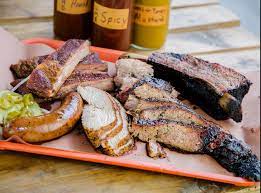
Well, the barbecue items, the smoked brisket, and the chopped barbecue,
are primarily used, let’s take them one at a time. The smoked brisket—and
we make two smoked briskets, one which we call the whole brisket, which
is just like it comes from the meat packer, with quite a bit of fat on
it, a whole brisket is a fat-covered piece of meat, and we do have some
customers that want it that way, they feel like it is more moist if it’s
been cooked that way, and I would agree with them, I think it is. But
you have a lot of fat that has been trimmed off, like in a barbecue restaurant,
that’s part of what they trim off before they put the meat on your
plate. But it is a very good product. So we have the whole brisket, and
then we have the trimmed brisket, and the trimmed brisket is a product,
it’s whole also in its configuration, but we have removed, before
seasoning and cooking it, we’ve removed on average about twenty
eight percent of its weight in fat. With the trimmed brisket, virtually
100 percent of it can go on a plate. Okay, who uses that? Well, restaurants
do. Not barbecue restaurants, because they will cook their own. But with
that brisket, with some of our sausage, beans that a restaurant can make,
potato salad that they can buy or make, slaw that they can buy or make,
they can have a barbecue plate even without having a barbecue pit. I would
say that’s where most of that goes. The chopped barbecue, concession
stands, where they’re wanting something that’s easy and good,
something that they can heat up, put on a bun, and give it to the customer.
Whether it’s a concession stand or a convenience store, even sometimes
we have customers that put it on a baked potato as a topping. So that’s
where most of that goes.
---
LP: Just to kind of piggyback on something you said there, what do
you think is kind of the place of sausage in the Texas barbecue culture?
Or, somewhat related to sausage, how is Texas barbecue or food is different
from food somewhere else or barbecue somewhere else or even sausage somewhere
else?
Well it’s the best. [Laughter] Well, because we have the mail order
and online customers as well, we get questions that are along those lines
sometimes. You know, asking us to describe our products and what is brisket.
“I’m from New York. What’s brisket?” In different
parts of the country, barbecue is, fortunately I guess, or unfortunately,
is different. In the Southeast, if you’re talking about barbecue,
well you’re talking about pork. Like I said, in New York City, if
you’re talking about brisket, you’re talking about corned
beef. And then there are different variations throughout the country especially
with seasoning and sauces. Some places want more of a vinegar-based sauce
and others places more of a sweet sauce. So there really are a lot of
differences. In Texas, I think that probably more so than any other place
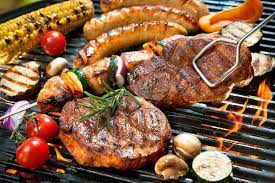
in the United States, sausage is an integral part of the barbecue menu.
In Texas we do it all. We have even chicken and you see turkey and you
see ham. And you know that's, maybe that arguably is not really barbecue,
but it's at least smoked meats and uh, but the mainstay in Texas is gonna
be brisket and sausage and different barbecue restaurants like to be known
for having a product that's a little bit different than anybody else has
or than somebody else has
and that's more difficult to do with brisket than it is with sausage.
With sausage, you can vary the meat ingredients, all the way from pork
to beef. I can't imagine any self-respecting barbecue restaurant in Texas
having anything that has chicken in it as far as sausage goes, but, or
turkey. But, uh, anyway, they can vary, in building, or in selecting the
sausage that they might want to use. They can go all the way from pork
to beef. They can vary the, the, uh, seasoning. We make some sausages
that have jalapeño in them and, you know, some that are very strong
with garlic and there's a whole range in between. You can also vary the
diameter of the casing, so that you have something that is, uh, on the
one hand may be very big in diameter and another one might want something
that is much smaller in diameter. We have made sausage portions all the
way from eight links to a pound, which is just two or three inches to,
we made a sausage for one of our customers for their grand opening that
was, I think, forty feet long.
LP: And you mentioned your enjoyment of the hot link. Do you have any
other specific favorite types of sausage, or favorite flavors that you
like to have in the sausage that you personally eat?
Well, the kielbasa jalapeno is one of my favorites, you know, I have people
ask the question, you know, like you just did and normally my stock answer
is, my favorite is whatever I'm eating at the time. But, the kielbasa
jalapeno, I love that sausage and that’s my wife's favorite. Because
of the way it looks. It is beautiful to see, you know, bright, real green,
not grey green, or anything, but, you know, green color, throughout the
sausage. I don't mean a green cast, I mean that there are specks, bigger
than specks, of green in there. So when you cut one of those sausages
on the diagonal or cross section, you see something that looks good. You
know, it's striking. The bratwurst, when you get it, it is made without
cure, so it is basically a very light color and it's also not smoked.
So it almost has a white, or a grayish, a very light colored appearance.
It's, it's beautiful in that respect and it's different looking. When
you put grill marks on that, you know, when you have it on a griddle,
or on a grill where you've got either a hot flat surface or a screen or
something, you see that branded into it, you know, and it's a beautiful
brown color. This makes you want to eat it just looking at it. I just,
I like it all.
---
LP: And you mentioned that in Dallas—Fort Worth they had nicknamed
your hot link, was there a particular nickname that they call it?
Yes, in our product, our hot link is known as Smokey D’s in the
Dallas—Fort Worth area. There has never been, that name has
never appeared on the outside of a box or in any kind of point of purchase
advertising. We have not referred to them as Smokey D’s. The public
has just given them that nickname.
---
LP: Do you have anything else that you'd like to have as part of your
recorded interview?
Just a, I guess, a recognition of what I think that you all are about
and a thank you. I know that you're examining and interviewing people
who have all kinds of different connections with this business, this industry
of barbecue. It's something that isn't just a place or a pit, or whatever,
it is a whole set of processes that come together. I mean, you've told
me that you've even gone out talked with people who secure the wood that
is used, by some, to smoke their meats with. And you ladies are young
and you all have not lived as much of life as I have. You haven't seen
things kind of fall by the wayside. But barbecue has not fallen by the
wayside. But, it is something that, like anything else, that is subject
to shortcutting, shortcutting, shortcutting. Like we've seen it already
with people spraying liquid smoke on sausages. There are even some that
are forming their sausages without casings now. I mean, this is kind of
experimental. But, uh, you know, I think what you're doing is worthwhile.
It's not just a project, it's, I think there's likely to be some lasting
benefits from it. In that it's the art of it, the result, the end product
of it is more likely to endure and flourish because of the preservation
of the information that you guys are putting together…Texas is very
hot right now. I mean, we Texans like to think that it always is. But,
I'm sure it kind of comes and goes. But, what we do in Texas is very popular
these days. And we Texans have a lot of pride in what we do.
---
To download the entire transcript in
PDF form, please click here.
bottom MENU
Introduction
| Map Overview | Oral
Histories | About & Contact | More
Trails...
|
 |